You’ve already conquered law school—now it’s time to tackle the bar exam. I know it can feel overwhelming just thinking about it, but the right study schedule can make all the difference and help you approach it with confidence.
And let’s face it, a schedule is important.
According to the American Bar Association, the aggregate pass rate for first-time bar exam takers in 2023 was 79.18%. That means a lot of people pass, but it also means a significant number don’t make it on the first try.
A well-thought-out bar prep period is your best bet for landing in that passing group. So, grab a coffee, and let’s talk about how to structure your bar study for success.
Key Takeaways
- Plan Your Attack: Account for 400-600 total study hours. This means 8-10 weeks for full-time study or 4-6+ months if you’re balancing a full-time job or other commitments.
- Personalize Your Path: Whether using a bar prep course or creating your own schedule, tailor it to your individual learning style and available time.
- Practice Makes Progress: Consistent, daily practice questions for all MBE subjects, MEE essays, and MPTs, along with timed practice tests, should be non-negotiable.
- Balance is Your Best Friend: Effectively allocate study time across all exam sections and balance your long study hours with sufficient breaks to avoid burnout.
- Flexibility Wins the Race: Your initial study schedule is a guide, not a rigid prison. Be prepared to adapt it as you learn what works best for you.
Decoding the Bar Exam: What You’re Up Against
Before we even sketch out a single day in your exam study schedule, it helps to know what the bar exam actually looks like. Most states use a two-day exam, often including these parts:
The Multistate Bar Examination (MBE)
This is a big one, often worth 50% of your score if you’re in a Uniform Bar Exam (UBE) jurisdiction. It’s a six-hour, 200 multiple-choice test covering seven core subjects:
- Civil Procedure
- Constitutional Law
- Contracts (including Sales under UCC Article 2)
- Criminal Law and Procedure
- Evidence
- Real Property
- Torts
The Multistate Essay Examination (MEE)
If you’re in a UBE state, this usually accounts for about 30% of your score. You’ll get six 30-minute essay questions. Besides the MBE subjects, the MEE can also test on:
- Business Associations (Agency, Partnership, Corporations, LLCs)
- Conflict of Laws
- Family Law
- Secured Transactions (UCC Article 9)
- Trusts and Estates
The Multistate Performance Test (MPT)
This part is all about practical lawyering skills and usually makes up the remaining 20% in UBE states. You’ll get a couple of 90-minute tasks where you’re given a file of documents and a library of legal authorities, and you have to produce something like a memo, brief, or client letter. The cool part? You don’t need to know outside law; it’s all in the provided materials.
Many states also require the Multistate Professional Responsibility Examination (MPRE), which tests legal ethics. This is usually taken and passed separately before you can be admitted to the bar, so it’s not typically part of your main bar study schedule in the same way.
Understanding these components helps you see why a scattergun approach to studying for the bar just won’t cut it. You need a plan!
Building Your Bar Exam Study Schedule
Alright, let’s get down to business. Crafting a bar exam study schedule is about creating a roadmap that guides you through the enormous amount of material you need to cover. It’s not just about putting in long hours; it’s about smart, structured bar study.
How Long Should You Study?
Bar prep programs recommend a total of 400 to 600 study hours. How this translates into weeks or months depends on your situation:
- Full-Time Study: If you can dedicate yourself to bar prep like it’s your job, you’re looking at 8 to 10 weeks. This usually means studying 40 to 50 hours per week.
- Part-Time Study: If you’re juggling bar exam preparation with a full-time job or other significant commitments, you’ll need a longer period. Think 4 to 6 months. This might mean 15 to 25 hours per week, or some folks aim for 20-35 hours a week by doing a couple of hours on weeknights and longer blocks on weekends.
The key is hitting that total hour target with focused effort. I can tell you from experience, trying to cram it all into a shorter time than you can realistically manage is a recipe for stress.
Daily and Weekly Structure
Once you’ve got your timeline, how do you break down the actual bar study?
Daily Hours:
- Full-time: Aim for 6 to 8 focused study hours per day. This isn’t eight straight hours of staring at a book! We’re talking productive time, broken up by sufficient breaks.
- Part-time: This will vary. Maybe it’s 2-3 hours on workdays (mornings before work, evenings after) and 5-6 hours on your days off.
Weekly Goals:
- Take one major MBE subject per week for the first 5-7 weeks, integrating related MEE topics and MPT practice.
- Always schedule at least one full rest day per week. Seriously, your brain needs it! Burnout is real.
Allocating Time: MBE, MEE, and MPT
A balanced exam study schedule gives appropriate attention to each part of the bar exam. Here’s a common approach for a UBE jurisdiction:
| Exam Component | Typical Duration for a 9-10 week plan | Key Considerations |
|---|---|---|
| MBE Subjects | First 5 weeks heavily focused | Law learned often overlaps with MEE. Aim for 3-4 days per subject, followed by integrated review. |
| MEE (Essays) | Approx. 2 weeks | Dedicate this time after building a strong MBE foundation. Focus on timed essay writing practice. |
| MPT (Performance Tests) | Integrated throughout; initial focus 2 days | Needs regular dedicated practice. Aim for ~20% of practice time. Don’t leave it only for the end. |
| Final Review | Last 2-4 weeks | Comprehensive review of all subjects, more practice tests, and dedicated time to shore up weak areas. |
The Power of Practice: Questions and Tests
I can’t stress this enough: practice questions and full practice tests are the cornerstone of effective bar exam preparation. Here’s why and how to integrate them:
Why Practice?
- Application: It’s one thing to “know” the law; it’s another to apply it to tricky fact patterns.
- Feedback: Practice shows you where you’re strong and, more importantly, where you’re weak.
- Familiarity: You’ll get used to how questions are phrased and the common traps.
- Endurance: Full practice tests build the mental stamina needed for bar exam day.
- Memorization: Getting questions wrong and understanding why actually helps you remember the rules better.
How to Integrate:
- Daily Doses: Do practice questions every day for the subjects you’re covering. Start with shorter, untimed sets to build understanding, then move to timed practice.
- MBE Questions: Aim for a significant number throughout your prep. Many successful students study by doing over 1,000, even 1,500+ MBE practice questions. Quality over quantity is important initially, but volume helps with pattern recognition.
- MEE Essays: Write full essays regularly. Don’t just outline them in your head. Practice issue spotting and IRAC.
- MPTs: Do several full MPTs under timed conditions.
- Mock Exams: Take at least one, ideally two or three, full-length simulated bar exams under real exam conditions. This is critical for pacing and anxiety management. Schedule these in the latter half of your bar study schedule.
Here is a quick bar exam strategy checklist to handle the above components:
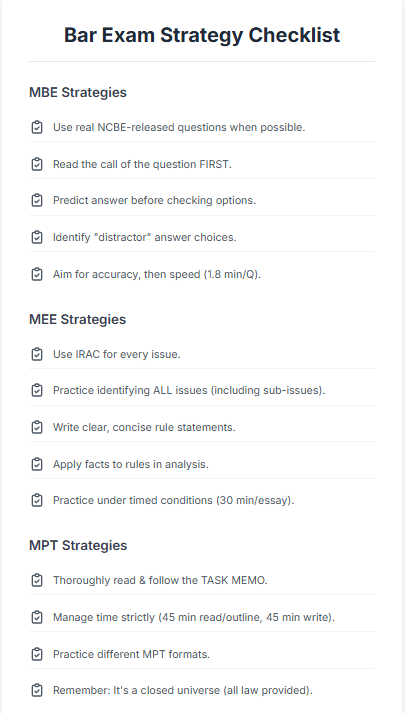
Remember, passively reading outlines isn’t enough. You need to actively engage with the material through practice.
Bar Prep Course vs. Your Own Bar Study Schedule
This is a big decision point for many. Should you follow the schedule laid out by bar prep courses, like Barmax, Barbri, Kaplan, etc., or should you craft your own bar study schedule from scratch? Or perhaps a bit of both? Let’s find out.
Bar Prep Courses: The Pros and Cons
Pros:
- Structure: They provide a comprehensive, day-by-day study schedule, which can be a lifesaver when you’re facing a mountain of material.
- Materials: You get curated outlines, lectures, and a ton of practice questions and practice tests.
- Expertise: These courses are designed by people who know the bar exam inside and out.
- Adaptive Learning: Many now offer “personalized study plans” that use algorithms to adjust based on your performance in practice, focusing you on weaker areas.
- Accountability: Just having a schedule laid out by someone else can help some people stay on track.
Cons:
- Cost: They’re expensive!
- One-Size-Fits-Most: Even with “personalization,” the core structure might not perfectly fit your unique learning style, pace, or life commitments.
Crafting Your Own Bar Study Schedule: The Pros and Cons
Pros:
- Ultimate Customization: You can tailor everything to your learning preferences, strengths, weaknesses from law school, and available time.
- Focus: You can decide to spend more time on heavily weighted subjects or areas you know you struggle with.
- Cost-Effective: You can use free or lower-cost materials, like NCBE-released past questions.
Cons:
- Overwhelming: It can be incredibly daunting to create a comprehensive schedule from scratch.
- Risk of Gaps: You might unintentionally miss important topics or not allocate enough time to critical areas.
- Requires Discipline: You need a high level of self-motivation and discipline to stick to a self-made plan.
The Hybrid Approach: Best of Both Worlds?
For many, the most effective path is a hybrid one:
- Use a Prep Course as a Foundation: Leverage their materials and general study schedule as a starting point.
- Aggressively Customize: Don’t just blindly follow the schedule.
- Know Thyself: Identify your learning style (visual, auditory, kinesthetic?).
- Assess Your Weaknesses: Be honest about which MBE subjects or MEE topics you struggled with in law school or find confusing. Your own bar study schedule should give this extra attention.
- Prioritize Active Learning: If a prep course has you watching 4 hours of video lectures a day, but you learn better by doing practice questions, adjust! Maybe watch lectures at 1.5x speed for familiar topics, or use the outlines more actively.
- Integrate Real Questions: Supplement prep course questions with actual released questions from the NCBE, if possible.
- Be Flexible: Your bar exam study schedule isn’t set in stone. If you’re falling behind or if a particular method isn’t working, reassess and adjust.
Even with a review course, you still need to create your detailed daily plan – when exactly will you do those assignments? When will you eat, sleep, exercise, and take sufficient breaks? The course gives the “what,” but you define much of the “how and when” for your daily life.
Sample Study Schedule Frameworks
It’s often helpful to see what a bar exam study schedule can look like. Remember, these are templates; you’ll need to adapt them!
Full-Time Bar Study Schedule (10-Week Example)
This assumes about 40-50 hours of study per week, with one rest day.
| Weeks | Focus | Key Activities |
|---|---|---|
| 1-2 | MBE Fundamentals | Cover core MBE subjects (e.g., Torts, Contracts, Criminal Law, Civ Pro). Review outlines/lectures. Short sets of practice questions. |
| 3-5 | Expand to MEE/MPT & Reinforce MBE | Add MEE-specific subjects (e.g., Family Law, Biz Orgs). Start essay practice. Introduce MPTs. Continue daily MBE practice questions. |
| 6-7 | Simulate Exam Conditions & Deepen Essay/MPT Skills | Take a full-length mock bar exam. Review mistakes thoroughly. Ramp up timed essay writing and MPT practice. |
| 8-9 | Target Weak Areas & Refine | Based on the mock exam, focus on your weaker subjects. Drill MPTs. Refine issue-spotting and analysis. |
| Week 10 | Final Review & Rest | Comprehensive review of all subjects (flashcards, condensed outlines). Light practice questions. Another mock if time. Prioritize rest. |
Sample Full-Time Daily Structure (approx. 6-8 hours of study):
Morning Session
(e.g., 9:00 AM – 12:30 PM, with a break)
- MBE subject review (outlines/lectures).
- 30-50 MBE practice questions + answer review.
Afternoon Session
(e.g., 1:30 PM – 5:00 PM, with a break)
- MEE essay practice (writing full essays, reviewing model answers) OR MPT practice (full timed MPT).
Late Afternoon / Early Evening
(e.g., 1 hour)
- Review flashcards, work on memorization, or a light review of a different subject area.
Part-Time Bar Study Schedule (4-6 Month Example)
This is much more variable, but the principle is to cover the same ground over a longer period.
- Phase 1 (First ~1-2 Months): Focus heavily on learning/relearning core MBE subjects. Lighter volume of practice questions as you build understanding.
- Phase 2 (Next ~1-2 Months): Integrate MEE subjects and start regular essay and MPT practice. Increase MBE question volume.
- Phase 3 (Next ~1-2 Months): More intensive practice across all areas. Take at least one full mock exam. Focus on weaknesses.
- Final Month: Dedicated review, more practice tests, shoring up weak spots.
Sample Part-Time Weekly Structure (approx. 20-25 hours):
- Weekdays (e.g., 2-3 hours/evening): Focus on one activity: reviewing an outline section, doing a set of MBE questions, or outlining/writing one essay.
- Weekends (e.g., 5-8 hours/day): Longer blocks for lectures, more extensive practice question sets, timed MPTs, or a section of a mock exam.
The key for part-timers is consistency. Even a couple of focused hours on a weekday makes a difference.
Final Thoughts on Your Bar Exam Study Schedule
Creating and sticking to a bar exam study schedule is a monumental task; there’s no sugarcoating it. It requires discipline, resilience, and a whole lot of long hours. But it’s also your most powerful tool for conquering the bar exam.
Remember, the “perfect” study schedule is the one that works for you. Whether you’re using a bar prep course, designing your own bar study schedule, or blending the two, the principles of consistent effort, strategic practice, and self-care remain the same.
This bar prep period is a unique challenge, but with a smart approach to your bar study, you’re setting yourself up for success on bar exam day. Trust your preparation, stay focused, and remember why you started this journey after law school. You’re closer than you think!
FAQs
Full-time: 6–8 hours.
Working full-time: 2–4 hours on weekdays, longer on weekends.
Yes, but it takes discipline. Many use a bar course for structure and customize from there.
At least 1,000–1,500 MBE questions. Focus on timed practice for essays and MPTs.
Absolutely. Daily and weekly breaks help prevent burnout and boost focus.
Consistency and active learning, like practice questions, essays, and self-testing.